

News: Microelectronics
15 December 2025
CEA-Leti and ST demo path to fully monolithic silicon RF front-ends with 3D sequential integration
At the 71st IEEE International Electron Devices Meeting (IEDM 2025) in San Francisco (6–10 December), micro/nanotechnology R&D center CEA-Leti of Grenoble, France and STMicroelectronics of Geneva, Switzerland presented results showcasing key enablers for a new high-performance and versatile RF silicon platform cointegrating best-in-class active and passive devices used in RF and optical front-end modules (FEM). Their paper details 3D sequential integration of silicon-germanium (SiGe) heterojunction bipolar transistors (HBT), RF silicon-on-insulator (SOI) switches, and high-quality passives on a single wafer — opening a path to highly integrated, low parasitic, and targeting cost-efficient systems for next-generation wireless and wireline communications.
The paper ‘Unlocking High-Performance Si RF Platforms with SiGe HBT and RFSOI Switch Technologies’ describes how those high-performance components can be built directly on the same silicon wafer rather than packaged or stacked as separate chips. This can be achieved through 3D sequential integration, which layers different device types, such as SiGe HBT and SOI CMOS switches, without overheating the lower tiers during processing.
Efficient and cost-effective
“Our team has shown that high-performance SiGe HBT has been conceived to be compatible with the top-tier fabrication steps, and that trap-rich isolation can be localized and thermally robust, and low-temperature (600°C) SOI switches can match state-of-the-art figures of merits,” says CEA-Leti’s Thibaud Fache, lead author of the paper. “These results pave the way to an all-silicon RF front-end module that is efficient and cost-effective.”
The team showed that a localized trap-rich layer can achieve RF isolation and linearity comparable to costly commercial trap-rich substrates, while withstanding thermal cycles up to 600°C — preserving the performance of the underlying SiGe HBT layer.
From advanced research to manufacturable solutions’
By extending silicon’s reach of sequential integration into the RF domain, the CEA-Leti/ST team’s work points to a future of more accessible, energy-efficient connectivity. Fully integrated RF and optical front ends could simplify manufacturing and enable cost-effective deployment of dense wireless networks essential for smart cities, autonomous systems, and AI data centers.
“This joint result demonstrates a credible path from advanced research to manufacturable solutions,” says co-author Thomas Bordignon of ST. “By combining CEA-Leti’s sequential integration know-how with ST’s RF technology expertise, we’re enabling the co-integration of state-of-the-art SiGe HBT, switches and passive devices that are key elements of the FEM.”
Materials science milestone
Achieving a functioning RF partially depleted (PD) SOI switch at 600°C rather than standard ~1000°C is a first. Also, the process flow of this low-temperature device does not rely on new equipment or costly steps and is thus quickly industrially viable due to the relatively relaxed thermal budget constraints of the bottom tier (600°C). The team demonstrated high-quality, low-loss RF switches fabricated at 600°C, maintaining the performance of the SiGe HBT below and confirming the feasibility of a fully integrated silicon RF platform.
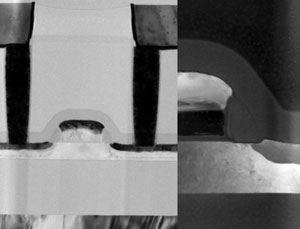 Picture: TEM cross section of 600°C RF switch processed on standard TR commercial wafer. (Photo: Julie Loche/STMicroelectronics.)
Additional breakthrough presentation
CEA-Leti researchers also reported a breakthrough (session 33-4) with the design of high-performance silicon-on-insulator (SOI) MOSFETs processed at 400°C. NMOS and pMOS transistors demonstrate state-of-the-art performances among the back-end-of-line devices, fulfilling all industrial figures of merit without any compromise.
Leti says that this reliable versatile analog transistor targets More Than Moore applications bringing differential advantage for smart sensors, near memory computing and RF devices. More details in “33-4 | High Performance 2.5V N&P 400°C SOI MOSFETs: A Breakthrough for Versatile 3D Sequential Integration”.