

News: Optoelectronics
9 April 2026
Vector Photonics demos free-space optical communication using PCSEL outside of a lab
Vector Photonics Ltd of the West of Scotland Science Park (which was spun off from the University of Glasgow in 2020, based on research led by professor Richard Hogg) has announced the first successful public demonstration of photonic crystal surface-emitting lasers (PCSEL) technology for optical communication outside of a lab. On 31 March, the firm’s PCSELs were used to transmit data across the River Clyde from the Glasgow Science Centre to the Clydeside Distillery, using a system designed and built by Fraunhofer UK.
“This is a major step forward for Vector Photonics, proving that our technology is a commercial reality in real-world applications,” says CEO & founder Dr Richard Taylor. “The demo is the most advanced application of a PCSEL to date, advancing it from a Technology Readiness level (TRL) of 4/5 to 6/7.” Employing the technology in open space means that it can perform successfully under different environmental conditions – temperature, humidity, precipitation, wind turbulence – and over a considerable distance. Previously, only lab experiments using ideal conditions and simulations have been attempted.
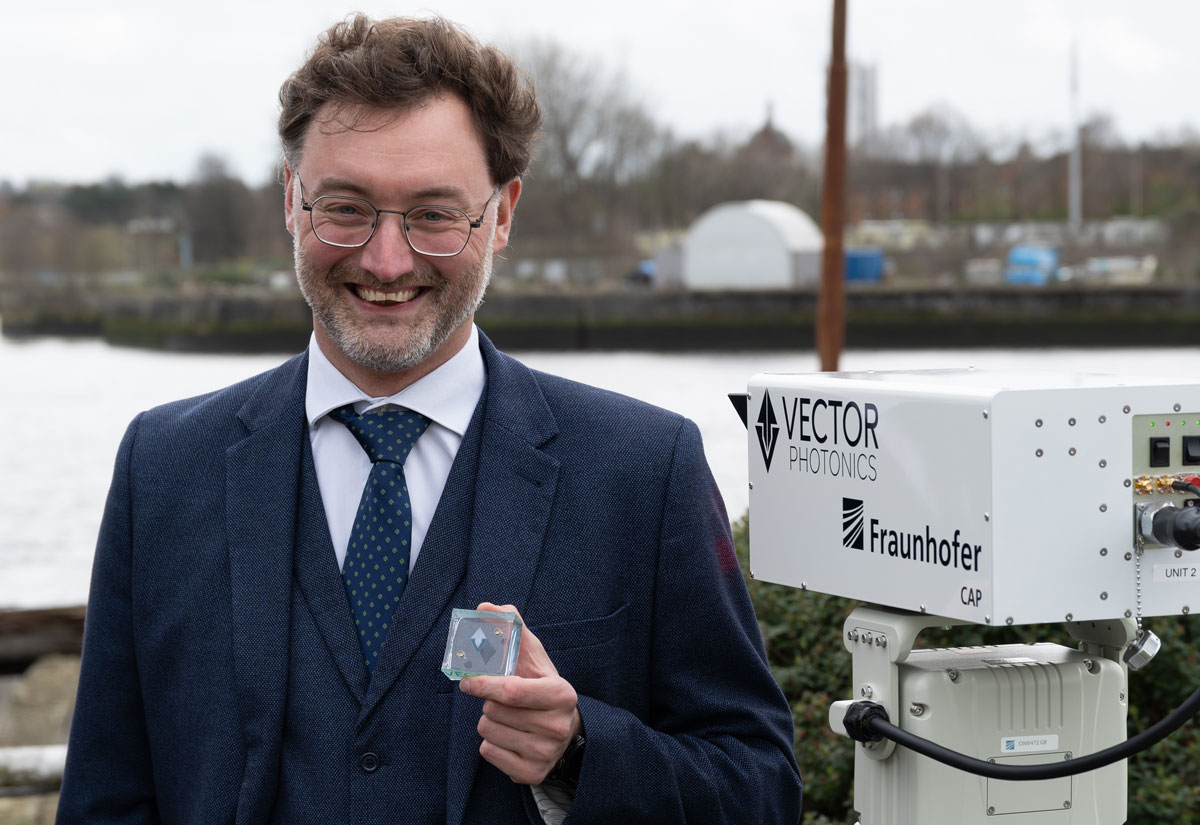
Picture: Vector Photonics’ CEO & founder Dr Richard Taylor with the PCSEL and optical communications system at the demo across the River Clyde.
PCSELs combine the high power of edge-emitting lasers with the speed and surface emission of vertical-cavity surface-emitting lasers (VCSEL). They are highly advantageous for secure, free-space optical communication systems due to their ability to emit narrow, high-brightness beams with excellent beam quality and low divergence, which is critical for minimizing signal loss over long distances. Unlike conventional laser sources, PCSELs combine the benefits of surface emission with coherent, single-mode output, enabling efficient coupling into free-space optics without the need for complex beam-shaping elements.
These properties position PCSELs as a next-generation laser source for compact free-space optical communication systems, enabling faster, secure internet connections between buildings, campuses and even satellites, without relying on cables or radio signals, says Vector Photonics. With its wide wavelength flexibility spanning ultraviolet to far-infrared, PCSEL technology can also be applied to artificial intelligence (AI) data centers, LiDAR systems and additive manufacturing (3D printing).
The free-space optical communication system was designed and constructed using Vector Photonics’ PCSELs by Fraunhofer UK’s Fraunhofer Centre for Applied Photonics, which is a not-for-profit research and technology organisation (RTO) established in Glasgow in 2012 in partnership with the University of Strathclyde and based in the Technology & Innovation Centre, in Glasgow City Innovation District. Data transfer at 50Mbps was demonstrated over 500m, with error rates below standard forward-error correction thresholds. This was twice the system spec required for the experiment, but well below the figure achievable by PCSELs, which have a naturally high data rate.
“This project has been a great opportunity to deploy Fraunhofer CAP’ s capabilities in the development of optical systems to assist Vector Photonics in demonstrating the growing maturity of PCSELs and the potential of this important new diode laser technology in optical communications,” comments Fraunhofer CAP’s principal researcher Dr Gerald Bonner.