

News: Suppliers
10 August 2026
Aixtron’s revenue almost doubles in Q2/2026, driven by opto boom
For first-half 2026, deposition equipment maker Aixtron SE of Herzogenrath, near Aachen, Germany has reported revenue of €174.5m, down 30% on first-half 2025’s €249.9m.
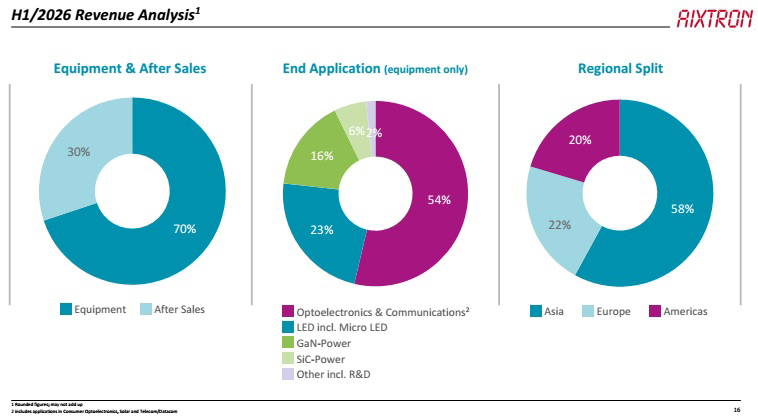
Of total revenue, after-sales business remained stable year-on-year at about €52m, while equipment sales fell by 38% from €197.8m to €122m.
Of total equipment revenue, power electronics applications contributed just 22% (plummeting from 71% a year ago). Specifically, metal-organic chemical vapor deposition (MOCVD) tools for gallium nitride (GaN) shrank from 26% to 16%, while chemical vapor deposition (CVD) tools for silicon carbide (SiC) slumped from 45% to just 6%.
MOCVD equipment for making LEDs and micro-LEDs has risen from 16% a year ago to 23% of equipment revenue, although demand remains soft.
MOCVD equipment for making optoelectronics and communications devices (telecoms/datacoms, consumer electronics, and solar) has boomed from just 9% of equipment revenue in first-half 2025 to 54% in first-half 2026, particularly for manufacturing lasers for optical datacoms and 3D sensing technology. “After the clear inflection point we saw in Q1, the market continued to accelerate in Q2, driven by strong demand from AI data-center applications,” notes CEO Dr Felix Grawert.
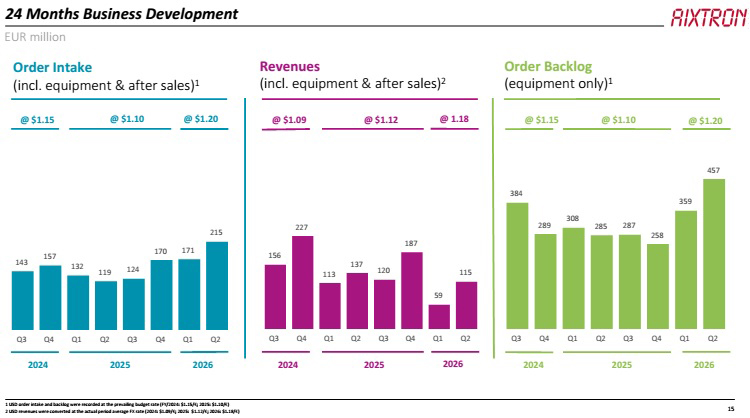
Despite being down 16% year-on-year on Q2/2025’s €137.4m, quarterly revenue has rebounded from €59.4m in Q1/2026 by almost doubling to €115.1m in Q2/2026 (above the mid-point of the €110m±€10m guidance range). This reflects the ongoing ramp-up in photonics business as well as the emergence from Q1’s trough in power electronics.
Gross margin fell from 36% first-half 2025 to 33% in first-half 2026. However, as well as the lower production volume (particularly in Q1/2026), this included one-off expenses in the mid-single-digit-million Euro range related to a personnel reduction in the operations area (following a prior 10% staff reduction between mid-2025 and mid-2026, from 1155 to 1035). This is intended to create a more flexible operating structure in light of the very soft business outlook at the beginning of the year. Subsequently, quarterly gross margin recovered from just 18% in Q1 to 41% in Q2 (back level with a year ago).
Return to profitability in Q2
Operating expenses increased by 3% from first-half 2025’s €63m to €65.2m in first-half 2026, due to R&D expenses rising by 31% from €36m to €47m (as Aixtron continues to invest in technology growth).
Compared with an operating profit (EBIT) of +€26.9m (EBIT margin of +11% of revenue) in first-half 2025, in first-half 2026 Aixtron recorded EBIT of –€7.6m (–4% margin), due mainly to the lower revenue volume and the one-off expense for personnel reduction in Q1. However, compared with –€22.3m (–38% margin) in Q1, EBIT was +€14.7m (+13% margin) in Q2, reflecting the higher revenue level and improved operating leverage.
Compared with a net profit of €24.3m (€0.22 per share) in first-half 2025, Aixtron recorded a net loss of –€2.8m (–€0.02 per share) in first-half 2026. However, this was due to the net loss of –€21.9m (–€0.19 per share) in Q1. In contrast, Q2 returned a net profit of €19.1m (€0.17 per share), roughly level with €19.2m (€0.18 per share) in Q2/2025.
Cash flow generation more than doubles in Q2
Cash flow from operating activities has more than doubled year-on-year from €85.1m in first-half 2025 to €172.7m in first-half 2026. Of this, quarterly operating cash flow more than doubled from Q1/2026’s €53.6m to Q2’s €119m.
Capital expenditure (CapEx) in first-half 2026 was almost €11m. Free cash flow was hence €162.1m (more than doubling from first-half 2025’s €71.1m). Of this, Q2/2026 free cash flow was €113.6m, up on Q1’s €48.5m (and €41.3m in Q2/2025).
A key driver was the big increase in customer advance payments, reflecting the strong order intake and backlog, a favourable order composition, and individually agreed payment terms.
Cash and cash equivalents (including other current financial assets) rose during Q1/2026 from €224.6m to €272.7m. Following a dividend payment of €16.9m, this has now risen to €816.2m at the end of Q2/2026, due to the placement in April of the firm’s inaugural convertible bond, of €450m.
After deducting the liability component of the convertible bond of €349.2m, net financial assets are €467m, up from €273m at the end of Q1 and more than doubling from €222m at year-end 2025. After falling from 88% to 85% during Q1, the equity ratio has hence fallen to just 61% at the end of Q2.
“Free cash flow of €162.1m in the first half of the year and available liquidity of €816.2m provide us with substantial financial flexibility,” notes chief financial officer Dr Christian Danninger. “We are well positioned to execute the upcoming production ramp and develop our new site in Malaysia [a €40m investment in 2026–2027] while continuing to invest in our technology and operational capabilities,” he adds.
Order intake and order backlog
Order intake has grown by 54% from first-half 2025’s €250.7m to €386m in first-half 2026. Of this, Q2/2026 was €214.5m (up 25% on €171.4m in Q1 and 81% on €118.5m a year ago).
This was driven by exceptionally strong demand for optoelectronic systems that began to materialize in late Q1, growing by 36% from €118m in Q1 to €160m in Q2 (rising from 70% of equipment order intake to 75%). High multi-tool order activity (with major laser-related system shipments expected to begin in Q3) extends visibility well beyond 2026. “We expect order momentum in optoelectronics to remain at very high levels in the second half of the year,” says Grawert.
In contrast, LED/micro-LED system demand remained soft in first-half 2026.
Demand for systems for SiC & GaN power electronics also remained soft. Utilization rates at customers are gradually increasing, but an inflection point toward a market recovery is not yet visible.
As of end-June, equipment order backlog was €456.9m, up from €359.1m at the end of March and €257.8m at the end of 2025.
In addition to the strong order intake and backlog, the composition of current orders and individually agreed payment terms has boosted customer advance payments by more than €150m during first-half 2026 to €197m. This comprises about 43% of the equipment order backlog, and provides meaningful funding for the upcoming volume production ramp.
At the same time, inventories increased during first-half 2026 from €283.6m to €317.9m, mainly reflecting higher levels of work-in-progress for shipments scheduled in the coming quarters.
Raised 2026 full-year guidance confirmed
To serve all customers with shipments at their requested delivery dates, Aixtron is now ramping up production capacity at its own premises and in close collaboration with its suppliers, to realize growth in shipment volumes in Q3 and further in Q4.
Aixtron hence targets further revenue growth in Q3 to €180m±€20m, followed by about €200m in Q4.
So, despite the soft start to 2026, Aixtron says that it is on track to achieve its full-year revenue guidance, which on 14 April was raised from €520m±€30m to €560m±€30m. This comprises the first-half 2026 revenue of €175m, plus forecasted Q3–Q4/2026 after-sales revenue of about €55m, equipment order backlog (convertible into 2026 revenue) of about €235m, and new orders of €95m±€30m. So, second-half 2026’s revenue of about €385m should be more than double the first-half’s €175m.
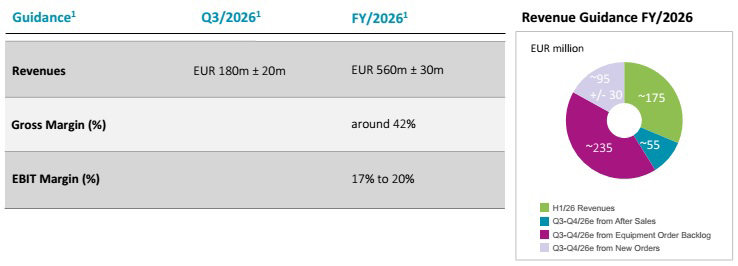
Aixtron also expects to achieve the raised guidance for gross margin of about 42% and for EBIT margin of 17–20%, which includes one-off expenses in the mid-single-digit-million Euro range related to the personnel reduction in operations.
For full-year 2026, CapEx should be about €55m, comprising baseline investments and about two-thirds of the €40m investment in the Malaysia expansion. The process to sell Aixtron’s production facility in Italy (valued at €7.1m) is ongoing.
“The first half of 2026 marked an important turning point for Aixtron,” says Grawert. “Strong order momentum in optoelectronics provides high visibility for the upcoming production ramp, while the convertible bond and our planned production site in Malaysia enhance our financial and operational flexibility.” Groundworks for the new building in Penang, Malaysia have already started, targeting a phased production ramp-up, to first system shipments by end-2027.
“We have positioned the company well to capture the full wave of accelerating optoelectronics demand,” believes Grawert. “At some point in time, power electronics will also restart and add to revenue growth.”
Aixtron’s Q1 revenue down 47% year-on-year, but opto drives 30% growth in orders
Aixtron to build new manufacturing plant in Malaysia
Aixtron’s Q3 revenue and margin impacted by volume shifts into Q4
Aixtron’s revenue grows 22% in Q2, driven by AI data-center communications