

News: Microelectronics
25 August 2026
Wolfspeed’s device revenue rebound driven by AI data center business
For fiscal fourth-quarter 2026, Wolfspeed Inc of Durham, NC, USA — which makes silicon carbide (SiC) materials and power semiconductor devices — has reported revenue of $149.6m, roughly level with $150.2m last quarter but down 24% on $197m a year ago.
Materials Products revenue has fallen further, by 45% from $78.4m a year ago and by 13.6% from $50.1m last quarter to $43.3m (driven largely by a tightening demand environment and increased competition in the market).
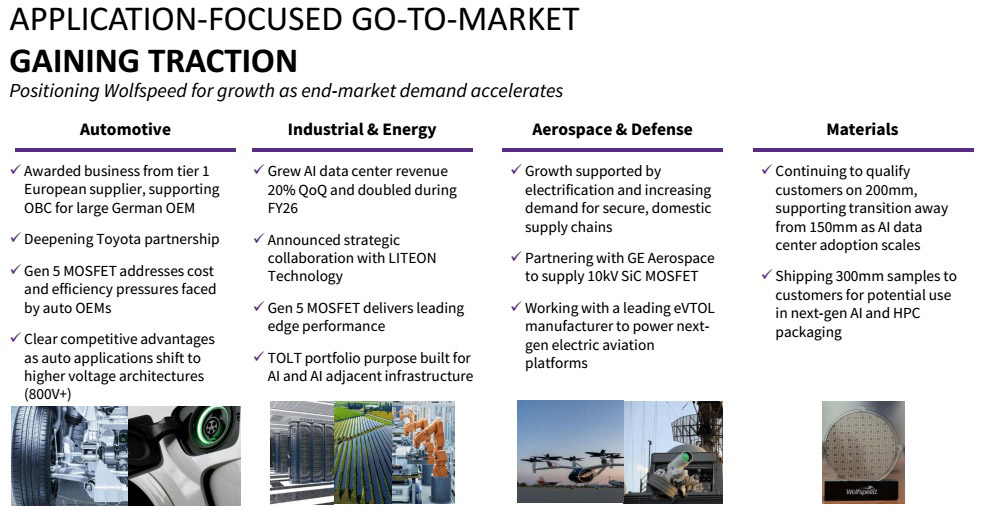
Power Products revenue was $106.3m, down 10.4% on $118.6m a year ago but rebounding by 6% from $100.1m last quarter. This was due to revenue for AI data centers growing 20% sequentially (and more than doubling for the full year, from fiscal 2025 to fiscal 2026), demonstrating the long-term potential of this moderate but growing opportunity. This helped to compensate for softer revenue from the automotive sector.
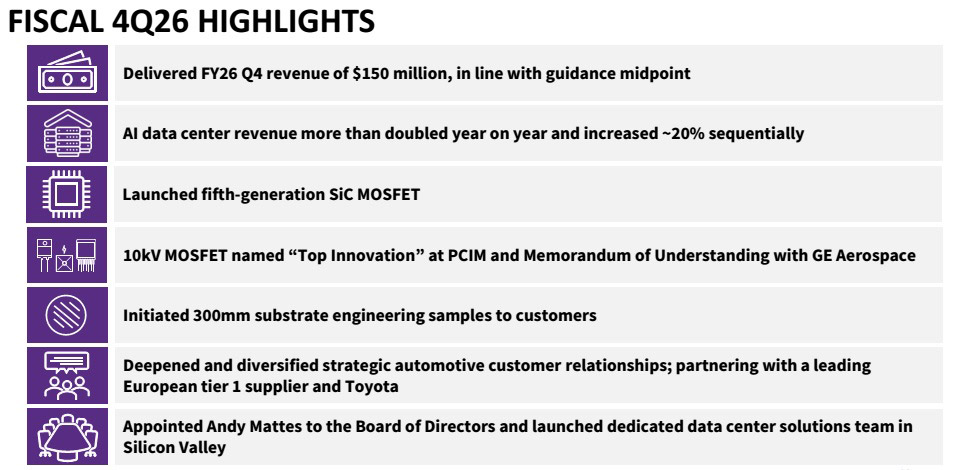
Business highlights during the quarter included:
- launching fifth-generation SiC MOSFET (running in the 20mm-wafer Mohawk Valley fab after rapid conversion from design-in to volume production), which enables more compact traction inverters, extended electric vehicle (EV) driving range, right-sized battery systems and improved EV charging infrastructure, as well as addressing industrial power supply applications that demand leading edge performance (including AI data-center power supplies, solid-state transformers, and renewable energy conversion);
- announcing a memorandum of understanding with GE Aerospace to collaborate on accelerating the adoption across industrial, aerospace and defense markets of high-voltage silicon carbide, including Wolfspeed supplying the industry’s first commercially available 10kV SiC MOSFET, which was named ‘Top Innovation’ at the Power Conversion and Intelligent Motion (PCIM 2026) conference;
- deepened and diversified strategic automotive customer relationships, including partnering with a leading European tier-1 supplier and Toyota;
- started shipping engineering samples of 300mm substrates to initial customers.
Margins and cash burn improved
Compared with –1% a year ago, gross margin (on a non-GAAP basis) was –19.9% in fiscal Q4/2026. However, this is a further rebound from –34% in fiscal Q2 then –20.6% in fiscal Q3, driven primarily by a more favorable product mix, including higher industrial & energy (I&E) sales in Power and higher RF sales in Materials. “Under-utilization continues to be the primary driver of our gross margin profile, and improving factory utilization remains one of the most important levers to drive margin expansion,” notes chief financial officer Gregor van Issum.
“We have also made great strides with our operational excellence initiatives,” says van Issum. “We continue to focus on producing the same revenue with less capacity consumed. These continued efforts position us to keep expanding our earnings potential per dollar of invested capital, even if it makes the reported under-utilization appear larger.”
Operating expenses were $62.3m, cut from $92.6m a year ago, but up slightly on $61m last quarter due largely to continued investment in R&D and marketing-related expenses.
Net loss has been cut further, from $128.2m last quarter to $116.9m ($2.26 per diluted share), below the $119.8m ($0.77 per diluted share) a year ago.
Operating cash flow has improved further, from –$242.5m a year ago and –$83.8m last quarter to –$54m, which included a $41m benefit from a further reduction in inventory levels.
Capital expenditure was only $5m, cut from $38m last quarter and $210.1m a year ago.
Free cash flow has therefore improved further, from –$454m a year ago and –$90m last quarter to –$60.9m.
Driven primarily by the continued reduction of inventory levels, changes in working capital contributed about $23m to cash.
During the quarter, cash, cash equivalents and short-term investments overall fell further, from $1165m to $1088m. However, this is still an improvement on $955.4m a year previously.
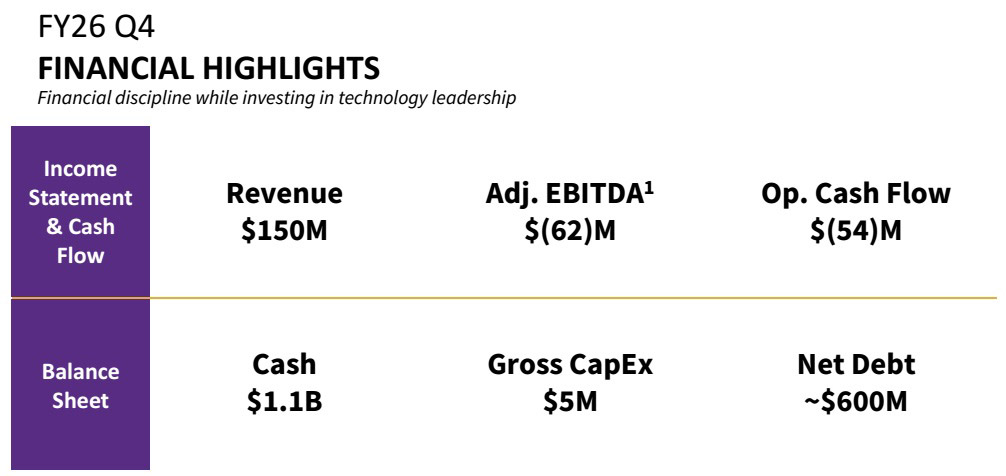
“We are aggressively targeting initiatives to further reduce our debt and cost of capital as well as enhance our financial positioning,” says van Issum. During the quarter, Wolfspeed’s capital structure further improved as holders of $46m of the firm’s 2L convertible notes exercised a voluntary conversion of their debt to equity. This debt principle decrease resulted in about $1m of annual interest expense savings. Net debt was about $600m at the end of the quarter.
September-quarter outlook
For fiscal first-quarter 2027 (to end-September 2026), Wolfspeed expects revenue of $140–160m, driven by continued growth in the device business.
Gross margin is expected to remain negative. Operating expenses should be $62–66m.
“We continued to expand our device business, highlighted by strong growth in AI data-center applications and the launch of our fifth-generation SiC MOSFET,” says CEO Robert Feurle. “These achievements strengthen our technology leadership and confidence in our long-term growth opportunities.”
In early June Wolfspeed launched a dedicated data-center solutions team, based in Silicon Valley, to capitalize on and supplement growth in the fastest-growing end-market and a strategic collaboration with LITEON Technology.
“Our investment and focus on AI data-center applications is gaining momentum, reflected in both revenue growth and expanding customer traction,” says Feurle. “We continue to see encouraging progress as new design wins ramp at leading power supply companies, including LITEON, MACOM, and others, to support multiple hyperscaler customers. These wins span both established and emerging HVDC AI architectures,” he adds.
“Transition to 800V architectures is increasing silicon carbide content across the data-center power ecosystem. As these next-generation power architectures become a critical enabler of AI infrastructure, hyperscaler customers are placing greater emphasis on system efficiency, quality and supply assurance. Beyond AC/DC power supplies, we are seeing opportunities emerge across battery backup units, super-capacitors, eFuses, and high-voltage DC-to-DC conversion,” Feurle continues.
“We are also pursuing opportunities on the secondary side of high-voltage DC-to-DC conversion systems, which could further expand our addressable market over time. While the market remains in its early stages, we believe our technology leadership and available manufacturing capacity position us well to participate in this long-term growth opportunity. With industry-leading SiC technology and differentiated vertically integrated 200mm manufacturing capability, we are well positioned to support this transition as AI data-center adoption continues to scale.”
Wolfspeed’s quarterly margins and cash burn improved despite falling revenue
Wolfspeed appoints executives to strengthen leadership team
Wolfspeed cuts quarterly loss after CapEx slashed during restructuring
Wolfspeed’s quarterly revenue rebounds by 6%, led by 10% growth in Power Products