
News: Microelectronics
15 July 2026
NextGO Epi raises €2m in pre-seed funding
NextGO Epi of Berlin, Germany has secured a €2m pre-seed funding round led by Vireo Ventures, with participation from Ultratech Capital Partners, IBB Ventures, and angel investor Boris Habets.
Spun off in 2025 from Berlin-based Leibniz-Institut für Kristallzüchtung (IKZ) and supported also by Investitionsbank Berlin, INAM and Siltronic, NextGO Epi produces gallium oxide epitaxial wafers for next-generation power semiconductor devices.
Just one week after the European Commission unveiled Chips Act 2.0, the funding for NextGO Epi marks the first institutional backing for what is reckoned to be the only European company producing industrial-quality gallium oxide epitaxial wafers with diameters up to 4-inches.
Gallium oxide comes with a major efficiency improvement over the currently used silicon carbide: it is 10x more power-efficient, handles up to 6x higher voltage density, and can be produced for up to 75% less.
“Ultrawide-bandgap semiconductors are emerging as a critical enabling technology for next-generation high-voltage power electronics, and gallium oxide leads that field,” comments Vireo Ventures’ co-founder & managing partner Mischa Wetzel. “No other material can match its performance envelope.” Gallium oxide-based electronic devices can withstand higher voltages and are more efficient than existing silicon carbide or gallium nitride.
The most immediate application is EV charging. An EV charging station containing devices built with NextGO Epi’s product could charge a vehicle fully in 10 minutes (down from today’s 60 minutes) and reliably in winter (when lithium batteries typically perform worst). Beyond EVs, gallium oxide can improve the efficiency of renewable energy inverters, AI data-center infrastructure power supplies, grid transformer electronics, and defense equipment such as missile tracking systems.
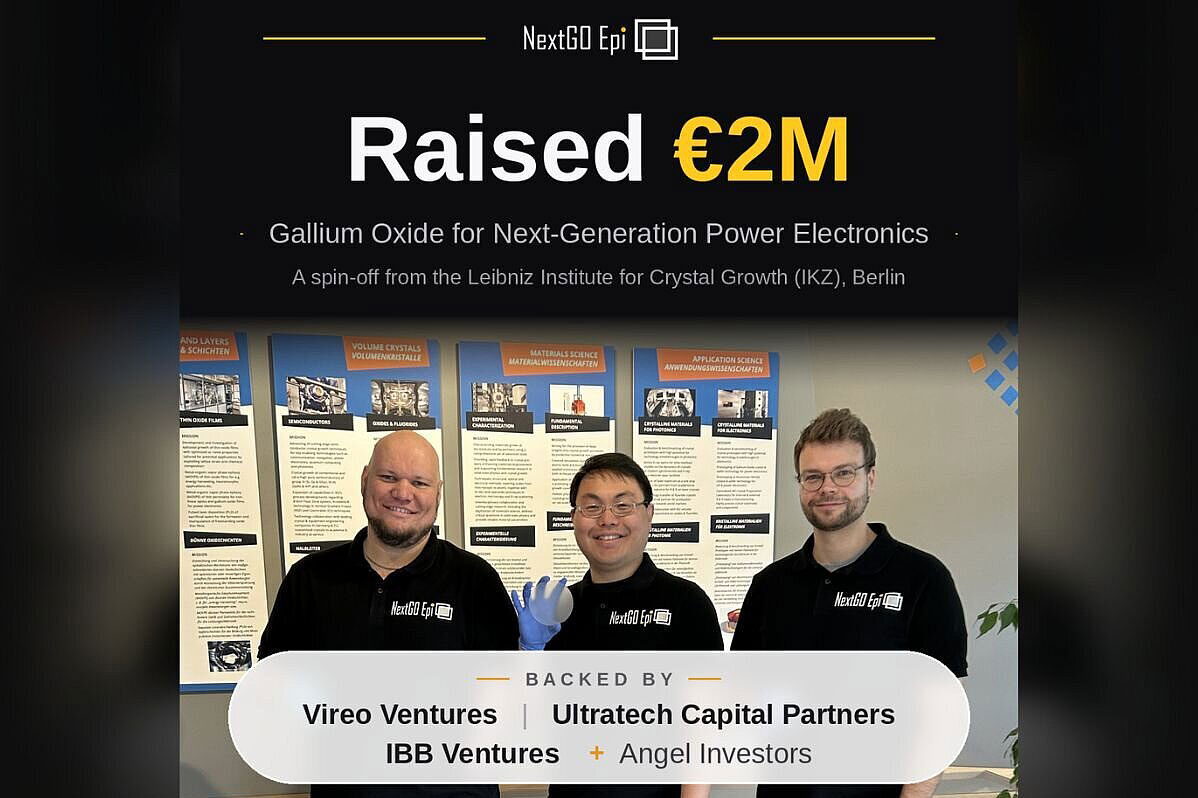
Picture: The NextGO Epi team (from left to right): Dr Andreas Fiedler, Dr Ta Shun Chou, and Dr Andreas Popp. (Photo courtsy of IKZ.)
“Gallium oxide is to power electronics what silicon was to compute, and Europe should own that value chain,” says NextGO Epi’s CEO & co-founder Dr Ta-Shun Chou. “We’re building the material layer that makes the next energy revolution possible,” he adds.
With support from IKZ, NextGO Epi’s founding team (Dr Ta-Shun Chou, Dr Andreas Popp and Dr Andreas Fiedler) has more than 10 years of combined experience in gallium oxide research and epitaxy, developing defect-free industrial-quality gallium oxide, underpinned by two international patents and 30+ scientific publications. The firm is further supported by Dr Jochen Linck, former chief operating officer of Aixtron, who has joined as operating partner to help guide NextGO Epi’s growth and commercial scale-up.
From lab to production: already delivering to customers
The company is already in production, generating revenue, and serving customers across three continents. “What sets NextGO Epi apart is that they’re not a research project: they're already in production, already delivering to customers, and virtually nobody else in the world can do what they do,” says Wetzel. “Their position, built on years of world-class research at IKZ, makes them a uniquely strong candidate to become a key supplier to this industry.”
The new capital for NextGO Epi should accelerate product development, grow the team, and strengthen the firm’s commercial presence across Europe and global markets.
Reducing Europe’s overdependence on Asian and US suppliers
Unveiled in June, Brussels’ new Chips Act 2.0 explicitly targets reducing Europe’s overdependence on Asian and US suppliers for the semiconductor materials that power EVs, AI servers, and the clean energy grid. NextGO Epi says that it is the type of company that the policy is designed to create, building the foundational supply chain that Europe needs to lead the next wave of energy and mobility transition.
All-GO-HEMT project gains €2m German funding to develop high-mobility gallium oxide