

News: Microelectronics
11 June 2026
Imec adds high-density MIMCAPs, passive modeling and laser-assisted bonding to 300mm RF silicon interposer platform
Nanoelectronics research center imec of Leuven, Belgium is evolving its 300mm RF silicon interposer into a system-level platform for the heterogeneous integration of III–V chiplets on Si-CMOS. By uniquely combining high-density embedded capacitors, a scalable modeling framework for passive components and laser-assisted bonding for III–V chiplet assembly, the platform lays the foundation for next-generation wireless (mmWave and sub-THz) systems, as well as RF-grade signal handling for ultrafast data-center applications.
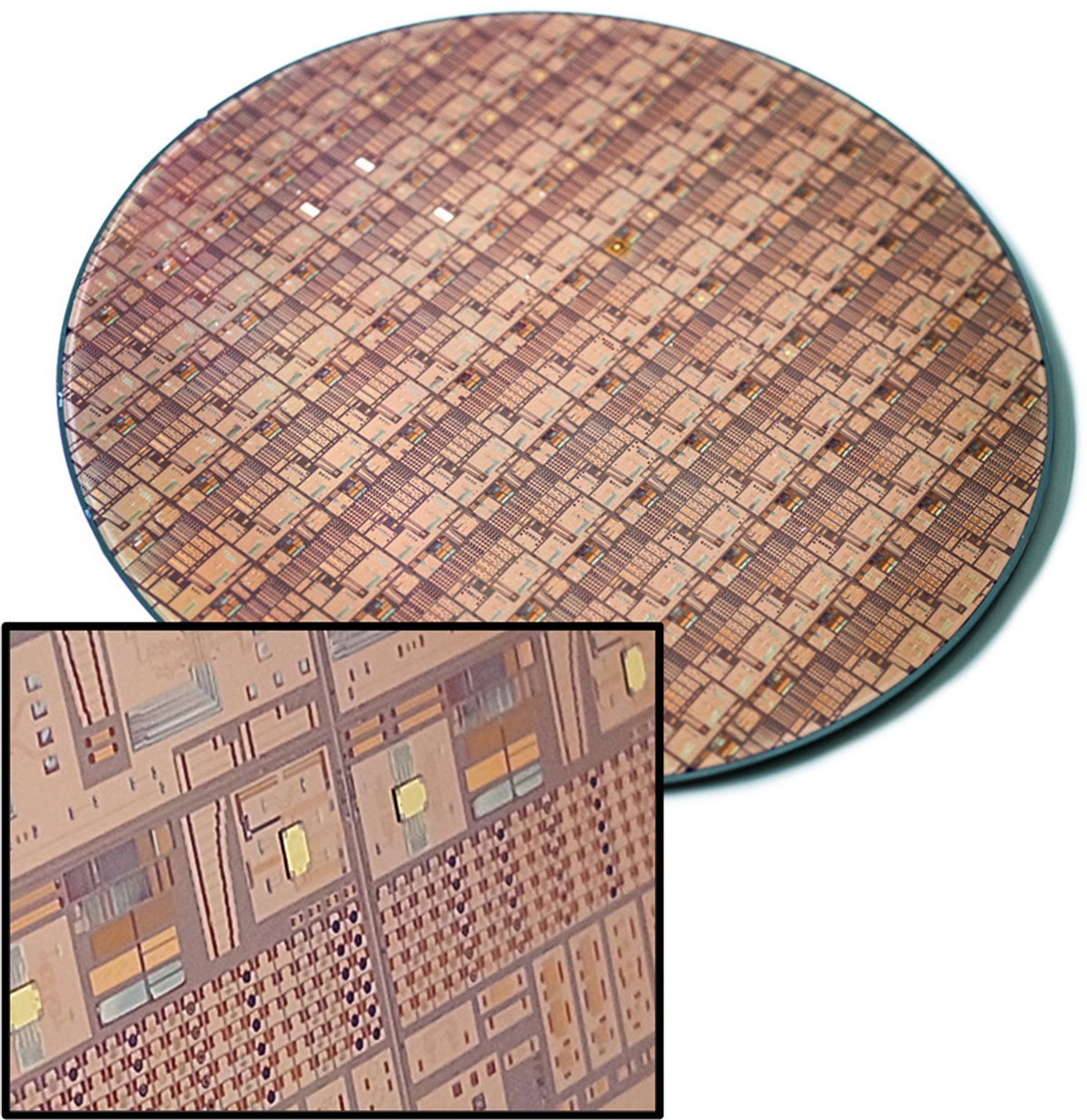
As wireless systems move into mmWave and sub-THz frequencies, and electronic and photonic interfaces in data centers are increasingly reaching their limits, it is becoming more difficult to deliver high-performance signal handling without driving up system integration complexity, cost, power consumption, and footprint.
A promising solution is to combine the superior gain, power and efficiency of III–V materials – such as indium phosphide (InP), gallium arsenide (GaAs) and gallium nitride (GaN) – with the scalability and cost efficiency of Si-CMOS technology. Chiplet-based heterogeneous integration on a high-performance RF silicon interposer makes this possible: it keeps performance-critical functions in compact III–V chiplets, while the interposer provides low-loss interconnects and hosts the remaining passive components.
Imec has been steadily advancing such a platform. In 2024, it demonstrated seamless InP chiplet integration on a 300mm RF silicon interposer with negligible insertion loss at 140GHz. In 2025, it extended the platform’s record-low insertion loss up to 325GHz. Now, imec has expanded this platform with three new, complementary enablers: high-density embedded capacitors, a scalable modeling framework for passive components, and laser-assisted bonding for III–V chiplet assembly.
A 10-to-100-fold increase in MIMCAP capacitance density for high compactness and cost efficiency
“A key lever to reduce III–V chiplet size and cost is the offloading of passive components – such as decoupling capacitors – onto the RF silicon interposer,” says Xiao Sun, principal member of technical staff at imec. “In a paper presented at this year’s IMS/RFIC conference, we demonstrate how combining this offloading approach with a new MIMCAP architecture enables a 10-to-100-fold increase in capacitance density compared to typical on-chip capacitors in III–V technologies. This supports more compact and cost-efficient system designs and improves power delivery for mmWave and sub-THz wireless systems as well as high-speed data-center applications.”
imec’s new MIM capacitor (MIMCAP) architecture combines a high-k aluminium–hafnium-oxide dielectric with three-dimensional (3D) oxide-stud structures in the back-end-of-line (BEOL).
Modeling framework for predictable design of passive components up to sub-THz frequencies
Complementing this effort, imec recently presented a modeling framework for RF interposer passives, validated up to the sub-THz regime (~300GHz). Imec’s model enables designers to accurately predict circuit performance as geometries change, without needing to re-simulate or measure every variation, significantly reducing development time.
To date, imec’s framework has focused on transmission line performance – but lays the foundation for a comprehensive design library that is being extended to other passive components, including inductors and MIMCAPs.
Laser-assisted bonding enables assembly of passive-rich III–V chiplet systems
Finally, imec demonstrated the use of laser-assisted bonding to integrate III–V chiplets onto its RF silicon interposer, enabling assembly of chiplets on a complex, passives-rich stack without compromising thermal budgets, or damaging temperature-sensitive interposer layers.
imec’s approach achieves alignment accuracy below 600nm, and rotational misalignment below 0.05° across 43 devices. RF measurements confirm preserved performance after assembly, with reflection below −15dB in the 110–170GHz range, demonstrating a viable path toward fully assembled high-frequency chiplet-based systems.
“With this work, we demonstrate a uniquely integrated platform that brings together performance, scalability, and manufacturability,” says Xiao Sun. “Our next priority is to further advance the platform’s technology readiness, and to enable support for low-volume manufacturing – helping our partners more easily develop and scale next-generation RF systems.”
Further technical details can be found in imec’s recent conference papers presented at the IEEE 76th Electronic Components and Technology Conference (ECTC 2026) in Orlando, FL, USA (26–29 May) and the IEEE/MTT-S International Microwave Symposium (IMS 2026) in Boston, MA, USA (7–12 June).
Imec integrates InP chiplet on 300mm RF silicon interposer, yielding 0.1dB insertion loss at 140GHz