
News: Suppliers
5 March 2026
Volta initiates bioleaching gallium recovery study with Laurentian University
Mineral exploration company Volta Metals Ltd of Toronto, Canada (which owns, has optioned and is currently exploring a critical minerals portfolio of rare-earths, gallium, lithium, cesium and tantalum projects in Ontario) has begun laboratory-scale bioleaching recovery test work primarily targeting gallium and secondarily rare-earth elements (REEs) at Dr Vasu Appanna’s laboratory of Biomine Research and Development at Laurentian University in Sudbury, Ontario. Laurentian University is recognized for its applied research expertise in mining, mineral processing, and earth sciences.
The principal objective of the test program is to evaluate the use of bacteria and other non-invasive reagents to extract gallium from Volta’s Springer Rare and Gallium Deposit in Sturgeon Falls, east of Sudbury, Ontario.
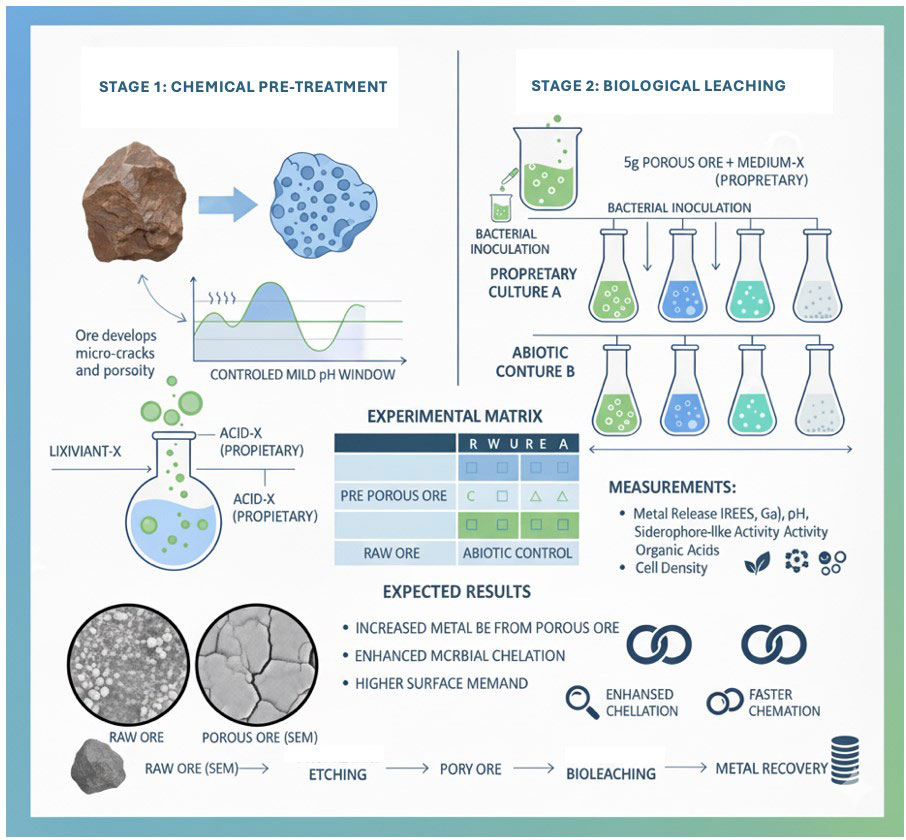
Picture: Dr Appanna's Proprietary Bioleaching System to recover metals.
Appanna (the former Dean of Laurentian University’s Faculty of Science and Engineering) is a recognized expert in gallium recovery and bioleaching technologies. Bioleaching is an established metallurgical process that has been applied at production scale in Chile’s copper industry for the recovery of metals in a low-impact and sustainable manner. Codelco operates the Radomiro Tomic mine in Chile, where full-scale bioleaching of low-grade run-of-mine ore has been implemented, with technical support from BioSigma S.A., a joint venture between Codelco and Nippon Mining and Metals. Bioleaching is also used at other major Chilean copper operations, including Escondida (owned by BHP, Rio Tinto and JECO), Spence (BHP), and Chuquicamata (Codelco).
Initial tests completed at Laurentian University
Volta has partnered with Appanna’s laboratory to evaluate innovative technologies for the recovery of gallium (and REEs) from mineralized material from the Springer deposit using microbial and chemical leaching systems. The bio-enabled leaching platform integrates specialized microbial groups, environmentally friendly chemical media and specialized affinity columns designed for the selective recovery of gallium (and REEs).
Volta submitted a small batch of Springer master mineral composites, representative of mineralization intersected to date, to Appanna’s laboratory for initial chemical leaching tests targeting gallium (and REEs). These initial tests successfully liberated multiple critical elements into solution, including gallium, neodymium, samarium and heavy REEs such as gadolinium (Gd), dysprosium (Dy), and ytterbium (Y).
Next phase: dual Earth extraction pathways
The next phase of laboratory-scale testing, currently underway, is designed to identify optimal chemical and microbial conditions to efficiently liberate gallium (and REEs) from the Springer Deposit’s mineralized material matrices. Results are expected in third-quarter 2026.
Contingent on positive results, the testwork will form the basis for subsequent bulk leach validation studies, advancing the process toward potential scale-up.
This sustainable extraction approach is expected to further unlock Springer’s potential by supporting the efficient, domestic supply of highly critical and strategic elements.