
News: Microelectronics
22 May 2026
Infineon-led European project Moore4Power launches
Coordinated by Infineon Technologies AG of Munich, Germany, the European semiconductor R&D project Moore4Power (More than Moore for Disruptive Innovations in Power Electronics) has been officially launched.
With a total project volume of €91m and running for three years, the project is co‑funded by grants from the participating countries and the European Union’s Horizon Europe – Chips Joint Undertaking (Innovation Action) program.
The initiative unites 62 large entities, small- and medium-sized enterprises and research institutes from 15 European countries to develop the next generation of smart, efficient and sustainable power electronics. Moore4Power aims to deliver breakthrough innovations that strengthen Europe’s technological sovereignty and sustainability in power electronics.
For decades, progress in electronics followed Moore’s Law: smaller transistors, delivering higher performance at lower cost. Traditional scaling is reaching physical and economic limits. Moore4Power addresses this challenge by shifting the focus from individual components to system-level innovation. Combining technologies, materials and functions in smarter, application-driven ways, the initiative aims to unlock major gains in efficiency, reliability and power density.
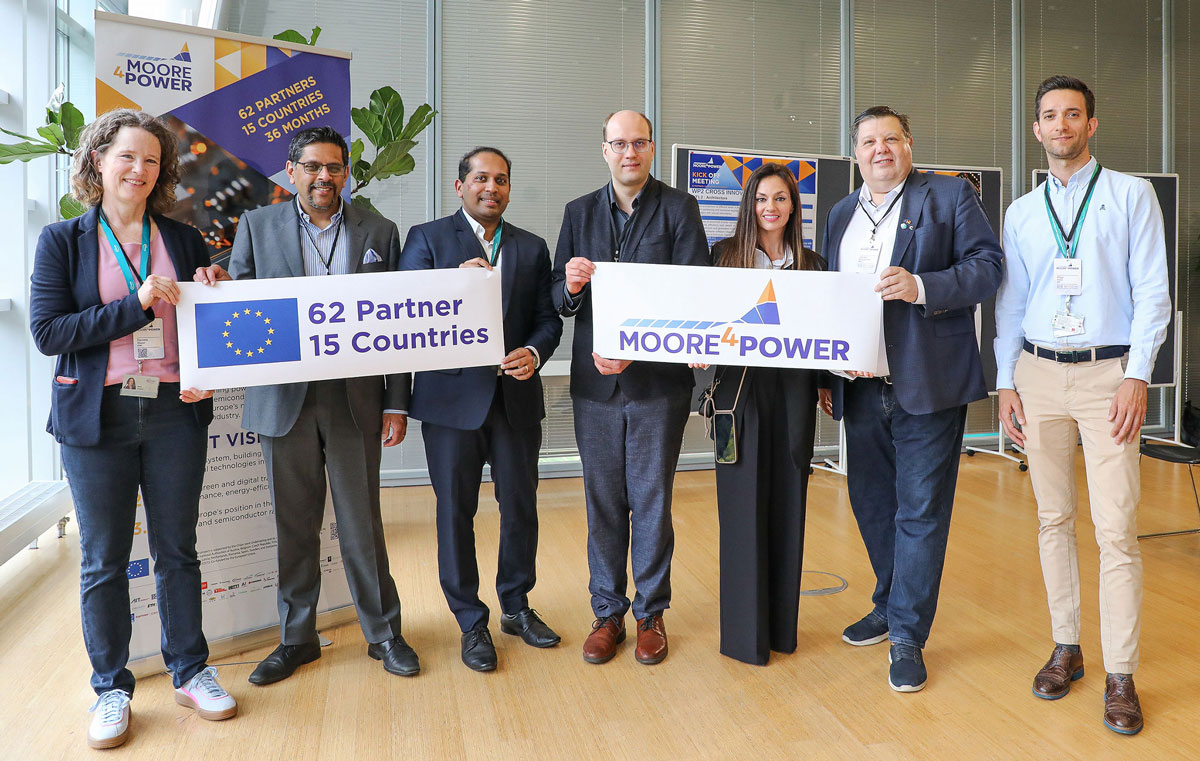
Picture: Kick-off event for Moore4Power project (from left to right): Daniela Maier (project lead Infineon), Ganesh Chandramouli (head of Innovation ALSTOM), Jain Chacko (research scientist at Fraunhofer ENAS), Joonas Leppanen (senior principal engineer R&D at ABB Finland),Vicky Chatzidogiannaki (director at INNOVATION DISCO), Jochen Koszescha (project coordinator Moore4Power Infineon), Iñigo Polo (general technology manager at INGETEAM).
“Power electronics are a decisive enabler for energy efficiency and sustainability. With Moore4Power, we are setting the next level of smart integration to achieve significantly higher energy and resource efficiency,” says Jochen Koszescha, coordination lead for the Moore4Power project at Infineon. “We are proud to join forces with an outstanding consortium from academia, research and industry to make a decisive contribution to Europe’s Clean Industrial Deal.”
Smarter integration beyond traditional scaling
At the core of Moore4Power is heterogeneous integration, which combines different semiconductor technologies such as silicon (Si), silicon carbide (SiC) and gallium nitride (GaN), together with sensing, control and communication functions to form tightly integrated systems. Each technology is used where it performs best, enabling higher efficiency, improved reliability and more compact designs. Power chiplet technology enables scalable architectures and more flexible product variants at globally competitive cost levels. This modular approach will pave the way for next-generation solutions in a wide range of highly relevant applications.
The foundation was laid in the predecessor project PowerizeD, a large Chips JU-funded project completed in 2025, which delivered advances in efficiency and reliability.
More performance for energy, mobility and industry
Moore4Power focuses on high‑impact sectors where power conversion drives cost, CO2 reduction and reliability. In wind energy, advanced power electronics can operate at the core of turbines to improve energy conversion and increase harvested power; in e‑mobility, advanced power electronics will enable up to 99% efficiency with near‑loss‑free, bidirectional charging; and in railway systems, they will cut propulsion losses by at least 30 %, significantly boosting energy efficiency.
Faster development through digital intelligence
In Moore4Power, AI‑assisted models, digital twins and automated workflows will be used to shorten development cycles. Hardware and software will be designed in parallel to reduce simulation time while increasing accuracy. As a result, the time from first fab samples to a validated datasheet release can be reduced to just one week, it is reckoned, compared to several weeks currently. This acceleration should reduce costs, speed up industrialization and strengthen Europe’s industrial competitiveness. The first scalable demonstrators will be tested under real-word conditions.
Sustainability built in from the start
A central achievement is the Digital Product Passport (DPP), embedded directly into power modules via wireless access. The DPP will provide lifecycle data such as operating conditions, state of health, and remaining lifetime throughout the product’s use. This transparency will enable smarter maintenance, longer product lifetimes, better reuse, and reduced raw material consumption – delivering substantial CO2 savings and contributing to Europe’s circular economy and climate goals.
Moore4Power: 62 partners from 15 countries
The Moore4Power consortium comprises:
Austria: Austrian Institute of Technology GmbH, EV Group E. Thallner GmbH, Hellpower Energy e.U. (HEPO), Infineon Technologies Austria AG (IFAT), Kompetenzzentrum Automobil- und Industrieelektronik GmbH (KAI), Silicon Austria Labs GmbH (SAL);
Belgium: Interuniversitair Micro-Electronica Centrum VZW (IMEC), Materialise NV (MATE), Sadechaf BV (SADE);
Czechia: i46 s.r.o. (i46), Vysoké učení technické v Brně (BUT);
Finland: Aalto-korkeakoulusäätiö sr (AALTO), ABB Oy, Kempower Oy (KEMP,| Lappeenrannan–Lahden teknillinen yliopisto (LUT), MSc electronics Oy (MSC), Vensum Power Oy (VENS);
France: Ampère SAS (AMP), Commissariat à l'Énergie Atomique et aux Énergies Alternatives (CEA), Institut VEDECOM (VEDE), SASU Rayione (RAY), Trialog SAS (TRIA);
Germany: Ansys Germany GmbH (ANSYS), Airbus Operations GmbH (A-D), Finepower GmbH (FPG), Fraunhofer ENAS (FHG), Hella GmbH & Co KGaA (HELLA),| Infineon Technologies AG (IFAG), Infineon Technologies Dresden AG & Co KG (IFD), Nano-Join GmbH (NANO), Ostbayerische Technische Hochschule Amberg-Weiden (OTH), Technische Universität Dortmund (TUDO), Universität Bremen (UBRE);
Greece: Innovation Dis.co Idiotiki Kefalaiouchiki Etaireia (DISCO);
Hungary: Budapesti Műszaki és Gazdaságtudományi Egyetem (BME), HUN-REN Energiatudományi Kutatóközpont (HUNREN), Infineon Technologies Cegléd (IFCE), Spinsplit Műszaki Kutató Fejlesztő Kft (SPIN);
Italy: Infineon Technologies Italia SRL (IFI), Università degli Studi di Milano-Bicocca (UMIB), Università degli Studi di Padova (UNIPD);
Latvia: Elektronikas un Datorzinātņu Institūts (EDI);
Netherlands: Prodrive Technologies Innovation Services B.V. (PTIS), Signify Netherlands B.V. (SIGN), Technische Universiteit Delft (TUDE), Technische Universiteit Eindhoven (TUE), Universiteit Twente (UTWEN), VSL B.V.;
Romania: Infineon Technologies Romania & Co SCS (IFRO), Universitatea Tehnică din Cluj-Napoca (UTCN);
Spain: Consejo Superior De Investigaciones Científicas (CSIC), Fagor Automation S. Coop, Frenetic Electronics S.L. (FREN), Ingeteam Power Technology S.A. (IPT), Ingeteam Research Institute S.L. (IRI), Power Smart Control S.L. (PSC), Universidad de Oviedo (UNOVI);
Sweden: Alstom Rail Sweden AB (ALST), Kungliga Tekniska högskolan (KTH, Rise Research Institutes of Sweden AB;
Switzerland: ABB Schweiz AG (ABBCH), Eidgenössische Technische Hochschule Zürich (ETHZ), Plexim GmbH (PLEXIM).