

News: Microelectronics
10 November 2026
Mitsubishi Electric suppresses frequency dispersion in GaN transistors using GaN substrates
Tokyo-based Mitsubishi Electric Corp claims that, for the first time in the world, it has elucidated the effects of frequency dispersion (whereby current values and other characteristics of high-frequency devices vary depending on the operating frequency) caused by crystal defects in a gallium nitride (GaN) transistor (fabricated from a single-crystal GaN epitaxial layer on a single-crystal GaN substrate) and demonstrated that frequency dispersion can be significantly suppressed.
The firm says that this makes it possible to consistently realize the inherently high performance of GaN, contributing to the miniaturization, improved performance, and lower power consumption of high-frequency equipment, including industrial microwave heating systems that use GaN transistors.
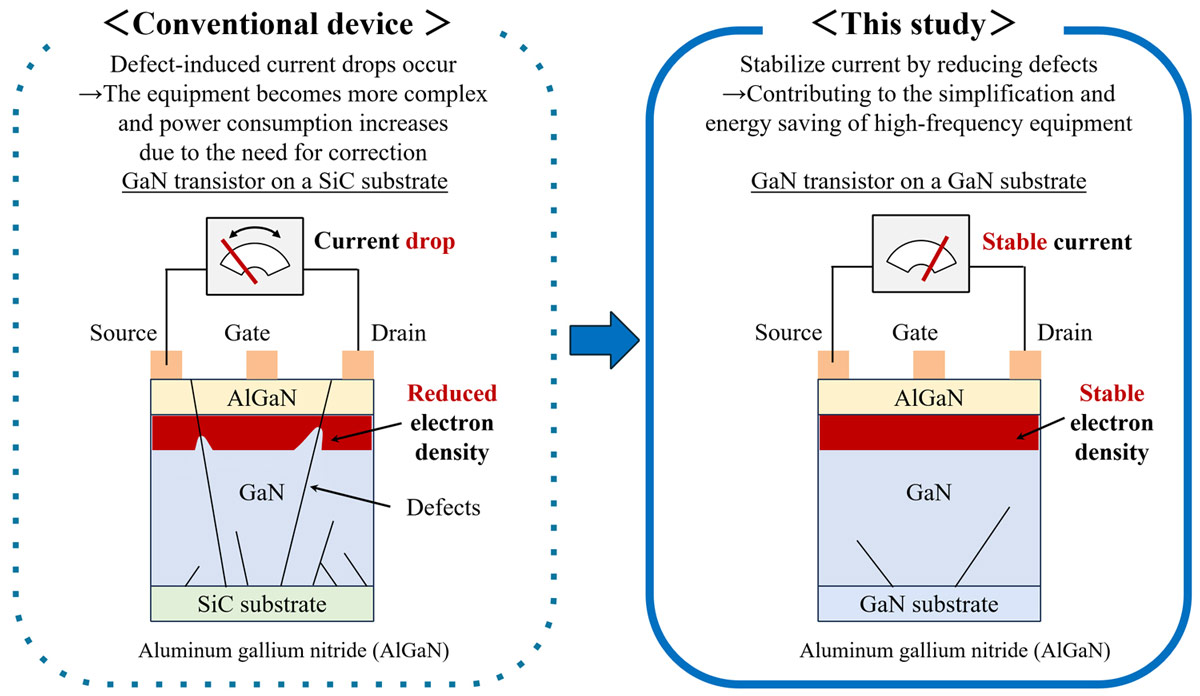
Picture: Comparison of crystal defects in GaN epitaxial layers on SiC and GaN substrates.
In recent years, demand for high-power, high-efficiency GaN transistors has been increasing rapidly in high-frequency fields, including industrial microwave heating systems used for chemical recycling (which converts waste plastics back into chemical raw materials) as well as 5G/6G base stations and radar systems. Conventional GaN transistors have mainly been fabricated by forming a GaN epitaxial layer on a silicon carbide (SiC) substrate, because SiC has high thermal conductivity and provides effective heat dissipation. However, crystal defects have been unavoidable during the film formation process due to the difference in materials between the substrate and the epitaxial layer.
These crystal defects impede the movement of electrons during high-frequency operation, causing frequency dispersion (in which current varies depending on the frequency) and resulting in unstable device operation. Consequently, complex correction using digital circuits has previously been required, making increased overall system size and greater power losses significant challenges.
As part of the project ‘Acceleration of Social Implementation and Dissemination of Components and Materials for Realizing Innovative CO2 Emission Reduction’ commissioned by Japan’s Ministry of the Environment, Mitsubishi Electric has elucidated the effects of crystal defects on frequency dispersion through the device characterization of GaN transistors incorporating GaN substrates (an area in which Japanese companies have particular strengths) using a new circuit analysis method that incorporates defect-related response.
Mitsubishi Electric says that by demonstrating, for the first time, that frequency dispersion can be significantly suppressed on a GaN substrate and that flat frequency characteristics can be obtained, it has made it possible to simplify the digital correction circuits that had previously been essential. This can contribute to the miniaturization, improved performance, and lower power consumption of high-frequency equipment, it reckons.
Details are being presented at the International Workshop on Nitride Semiconductors (IWN 2026) at Kumamoto Castle Hall in Kumamoto City, Japan (8–13 November).
Mitsubishi Electric unveils compact GaN power amplifier module with record-breaking power efficiency