

News: Microelectronics
27 October 2026
Infineon establishing first high-volume fab for GaN power semiconductors on 300mm wafers in Europe
Infineon Technologies AG of Munich, Germany is establishing the world’s first high-volume manufacturing facility for gallium nitride (GaN) power semiconductors on 300mm wafers in Europe. As part of the project, the firm will invest about €1.1bn in its existing cleanroom facilities at the site in Villach, Austria by 2034. Leveraging both the existing and upgraded infrastructure will enable efficient and cost-effective expansion of manufacturing capacity, it is reckoned. Production is scheduled to start by the end of 2027.
Infineon’s investment addresses the rapidly growing demand for high-performance power supply solutions, as gallium nitride enables significant efficiency gains in applications such as AI data centers, energy infrastructure, e-mobility, robotics and consumer electronics.
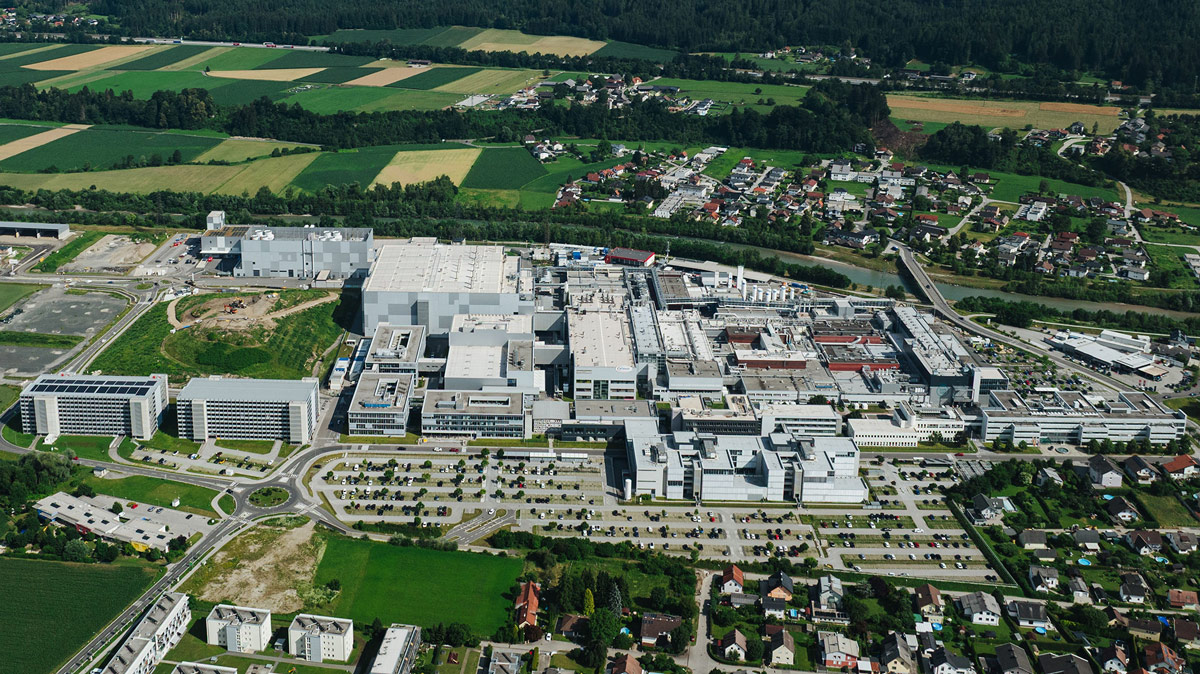
Picture: Infineon’s site in Villach, Austria.
Two years ago, Infineon achieved the milestone of processing the world’s first 300mm GaN wafers. Compared with 200mm wafers, the 300mm diameter enables the production of 2.3 times as many chips per wafer. Infineon is now transferring this more efficient technology to the first high-volume manufacturing facility serving customers.
“This substantial investment shows our clear commitment to strengthening the European semiconductor ecosystem and Europe’s technological sovereignty. By establishing high-volume manufacturing on 300mm wafers, we will be the first company in the world to bring gallium nitride power electronics into volume production,” says Infineon’s CEO Jochen Hanebeck. “In doing so, we are paving the way for the widespread use of gallium nitride in a wide range of key applications in areas such as artificial intelligence, energy infrastructure, e-mobility and robotics,” he adds.
“We are witnessing one of the largest single investments in the history of Austria’s high-tech industry,” states Christian Stocker, Federal Chancellor of the Republic of Austria. “This is not only a strong commitment to Austria as a business location but also helps ensure that the future of the semiconductor industry will not be shaped solely in Asia or the USA, but also in Austria and Europe,” he adds.
“Europe currently accounts for only around 10% of global chip production… We must also manufacture this key technology in Europe,” says Wolfgang Hattmannsdorfer, Austrian Federal Minister for Economic Affairs. “Austria is already a leader in energy-efficient chips. Relative to our population, we rank first in the EU in business R&D spending in the semiconductor sector. With our industrial strategy, we intend to build on this lead and not only research new technologies but also manufacture them on an industrial scale,” he adds. “Every job in the chip industry can provide six additional jobs across the broader economy. That is why we intend to support Infineon’s new chip production with up to €319m — subject to clear funding criteria for the location. This will ensure that public funds strengthen value creation and jobs in Austria over the long term.”
The investment is being supported under the European Chips Act. The European Commission has approved the €319m in state aid. The formal funding commitment by the Austrian Federal Ministry for Economic Affairs, Energy and Tourism is expected within the stipulated time limits.
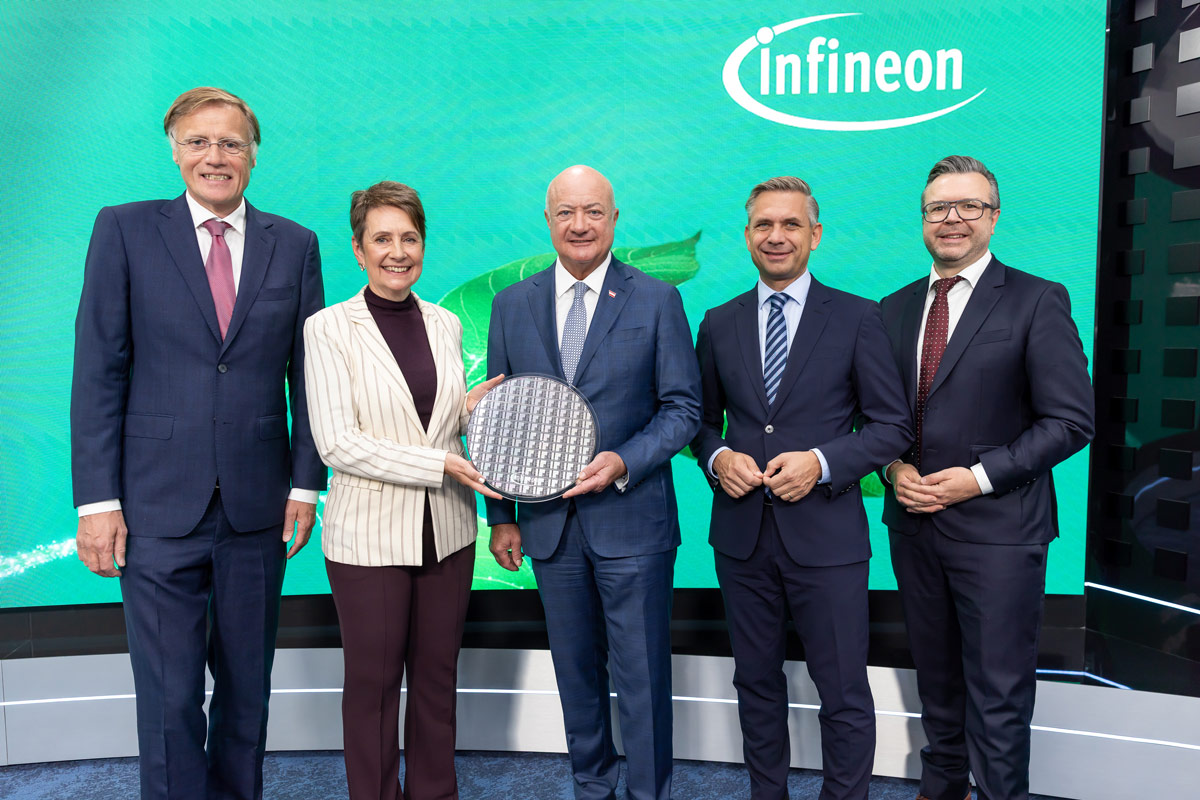
“Competitiveness and technological sovereignty emerge where excellent research is translated into industrial value creation. This is precisely where our flagship project comes in. From Austria, we are bringing innovation into industrial application, strengthening our technological leadership and securing highly skilled jobs,” says Infineon Technologies Austria AG’s CEO Sabine Herlitschka. “The entire Austrian semiconductor ecosystem benefits — from research organizations and universities to industrial partners. We are thus sustainably strengthening Europe’s competitiveness and strategic autonomy in microelectronics.”
Infineon reckons that the investment strengthens Villach’s role as a global competence center for power electronics and new semiconductor materials. Infineon Austria currently employs about 5800 people, including 4800 at the Villach site (as of end-September 2025). Together with universities, research institutions, start-ups and industry partners, Infineon forms the core of a microelectronics ecosystem in southern Austria. The establishment of the new 300mm GaN manufacturing facility is also expected to create synergies with the power electronics R&D activities in Villach.
Infineon on track to ship customer samples of GaN on 300mm wafers in Q4/2025
Infineon pilots first 300mm power GaN wafer technology on existing large-scale 300mm silicon line