

News: Markets
19 October 2026
Six leading opto component makers bet on VCSEL near-packaged optics
TrendForce’s latest report ‘2027 Infrared Sensing and Optical Communication Market Trend’ shows that rapidly growing demand for data transmission in expanding data-center networks is increasing interest in vertical-cavity surface-emitting laser (VCSEL)-based near-packaged optics (NPO). This technology is favored for its low power usage, easier maintenance, and a mature supply chain. Major companies like Lumentum, Furukawa Electric, Coherent, Broadcom, ams OSRAM, and HiSilicon are investing heavily in R&D.
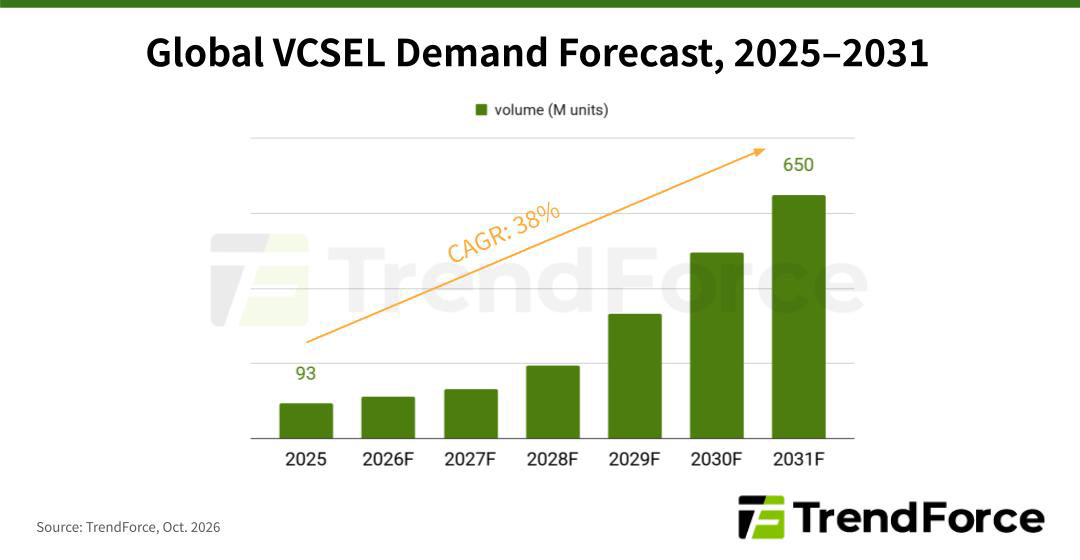
Several VCSEL NPO solutions are expected to launch between 2027 and 2028. Coupled with rising demand for short-reach optical transceivers, VCSEL sales are estimated to be rising at a compound annual growth rate (CAGR) of 38% from 2025 to 650 million units by 2031.
In scale-up network architectures for AI data centers, active electrical cables (AECs) primarily rely on multiple re-timers to mitigate data loss and signal attenuation. However, as transmission speeds advance into the 1.6Tbps era, high-frequency electrical signal attenuation over copper cables increases significantly. This is expected to accelerate the transition toward optical interconnect technologies for short-reach transmission, including architectures such as VCSEL NPO and micro-LED CPO.
Looking at supplier strategies, Lumentum, Furukawa Electric, Coherent, Broadcom, ams OSRAM, and HiSilicon are developing VCSEL NPO solutions to capture future opportunities in scale-up networks.
Coherent, Broadcom, ams OSRAM, and HiSilicon are adopting mature 850nm VCSELs paired with photodiodes to achieve aggregate bandwidth of up to 3.2Tbps, although chromatic dispersion will limit further improvements in transmission distance and bandwidth.
Lumentum and Furukawa Electric have adopted higher-cost 1060nm VCSEL solutions, while Coherent is also planning to adopt this approach. They offer extremely high fiber-coupling efficiency, low dispersion, low relative intensity noise (RIN), and strong performance at elevated operating temperatures, making them better suited to future increases in transmission speeds.
TrendForce notes that micro-LED CPO and VCSEL NPO require arrays of emitters and receivers to be integrated with ASICs/GPUs to achieve ultra-low power consumption and extremely high transmission density. Although micro-LED CPO offers long-term potential to approach the theoretical limit of energy consumption per bit, the technology continues to face challenges involving mass transfer, optical fiber compatibility, and coupling efficiency. Its supply chain also remains under development.
Compared with micro-LED CPO, VCSEL NPO offers more mature commercial conditions in terms of power consumption per bit, maintenance flexibility, and supply chain readiness. Both 850nm and 1060nm solutions can address the high-density transmission requirements of AI data centers. By offering a balance between performance and practical feasibility, VCSEL NPO has emerged as a highly competitive option for scale-up optical interconnect architectures at this stage.
Future VCSEL NPO development will focus on further improving overall performance. On the optical side, suppliers will seek to optimize the combination of VCSEL wavelengths and optical fiber technologies. At the chip level, development will focus on increasing the data rate of individual VCSELs from 100G to the 200G standard, as well as developing smaller micro-VCSELs with individual device sizes of 100–200µm. Higher-density, multi-channel arrays can then be used to further increase transmission bandwidth.
Overall, continued improvements in performance, technology maturity, and supply chain readiness are strengthening the competitive advantages of VCSEL NPO and accelerating the development of barriers to entry around the technology, summarizes TrendForce.
Micro-LED CPO optical transceiver market to reach $848m by 2030
Micro-LED co-packaged optics cut power consumption to just 5% that of copper cables