

News: LEDs
29 October 2026
Red GaN LED external quantum efficiency at 20.8%
University of California Santa Barbara (UCSB) in the USA reports work on planar indium gallium nitride (InGaN) red micro light-emitting diodes (μLEDs) on sapphire substrates achieving peak external quantum efficiency (EQE) and wall-plug efficiency (WPE) of up to 20.8% and 13.2%, respectively [Roark Chao et al, ACS Photonics, online 7 October 2026].
The device also performed well at higher operating temperatures. The team comments: “In comparison to room temperature, we observe <8nm peak emission wavelength shift at 200°C operating temperature with less than 26% reduction in light intensity.”
The EQE at 200°C was ~10%, “demonstrating a highly efficient and thermally resilient red InGaN/GaN μLED,” the team adds.
The μLED featured an annularly mediated distributed Bragg reflector (DBR) for enhanced light extraction, and avoided complex growth sequences. Such devices are being developed for full-color III−nitride displays and for visible light communication (VLC) applications.
The LED material was grown by metal-organic chemical vapor deposition on c-plane GaN/patterned sapphire substrate (PSS) template (Figure 1). The five InGaN quantum wells (QWs) were separated by GaN layers grown at high (HT), medium (MT) and low (LT) temperatures. The well itself was capped with aluminium gallium nitride. AlGaN was also used as an electron-blocking layer (EBL).
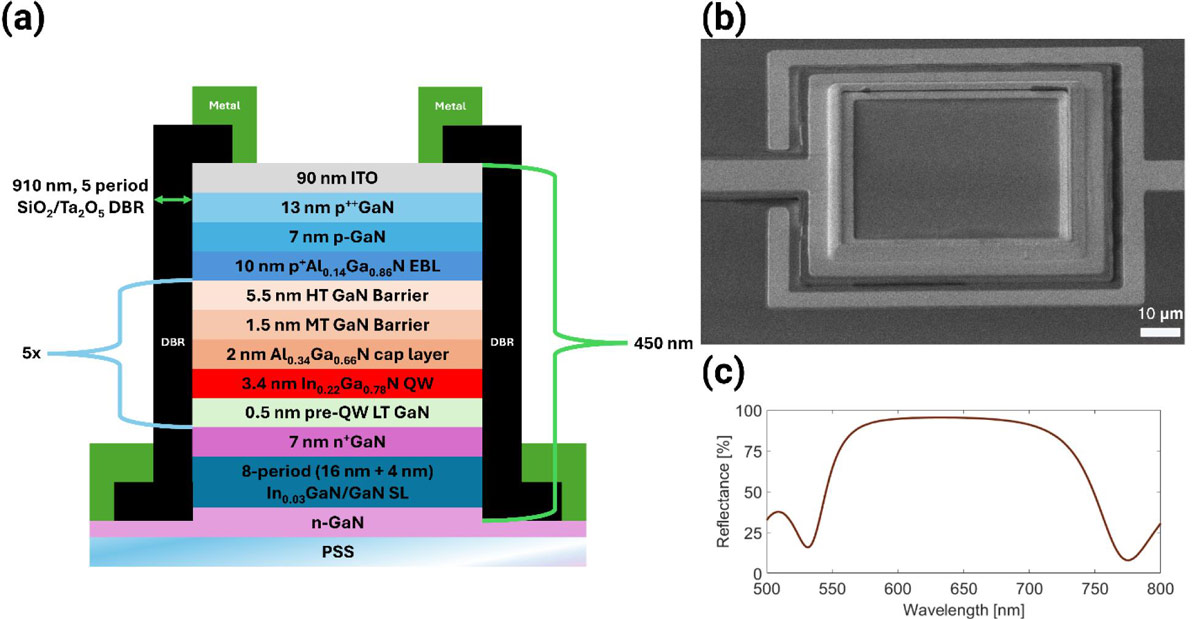
Figure 1: (a) LED epitaxy and fabrication scheme. (b) Scanning electron microscope (SEM) image of 60μm device. (c) Reflectance versus wavelength of sputtered DBR on silicon.
The fabricated devices included indium tin oxide (ITO) transparent conductor for current spreading, and a 5-period DBR on the sidewalls. The reflector used sputtered silicon dioxide (SiO2) and tantalum oxide (Ta2O5) layers.
The room-temperature turn-on voltage was 2.88V for 0.5A/cm2 current density. Under reverse bias down to −5V the leakage was less than 10−6A/cm2.
The single peak emission wavelength was 619nm ‘red’ at turn-on. Increasing current blue-shifts the peak to shorter wavelengths, reaching 589nm ‘amber’ at 150A/cm2 injection. The full-width at half maximum of the peak was between 40nm and 70nm up to 150A/cm2, decreasing initially and reaching a minimum around 5A/cm2 and then increasing.
Under increased temperature the peak wavelength tended to increase, around 7.5nm (606.8−599.3nm) at 50A/cm2 between 30°C and 200°C.
The researchers comment: “This positions our spectral performance as superior to other III−V (e.g. AlInGaP) μLEDs, where a ~10nm wavelength shift has been reported for a smaller 120°C temperature increase.”
The FWHM increased between 30°C and 200°C, going from 49.4nm to 58.6nm.
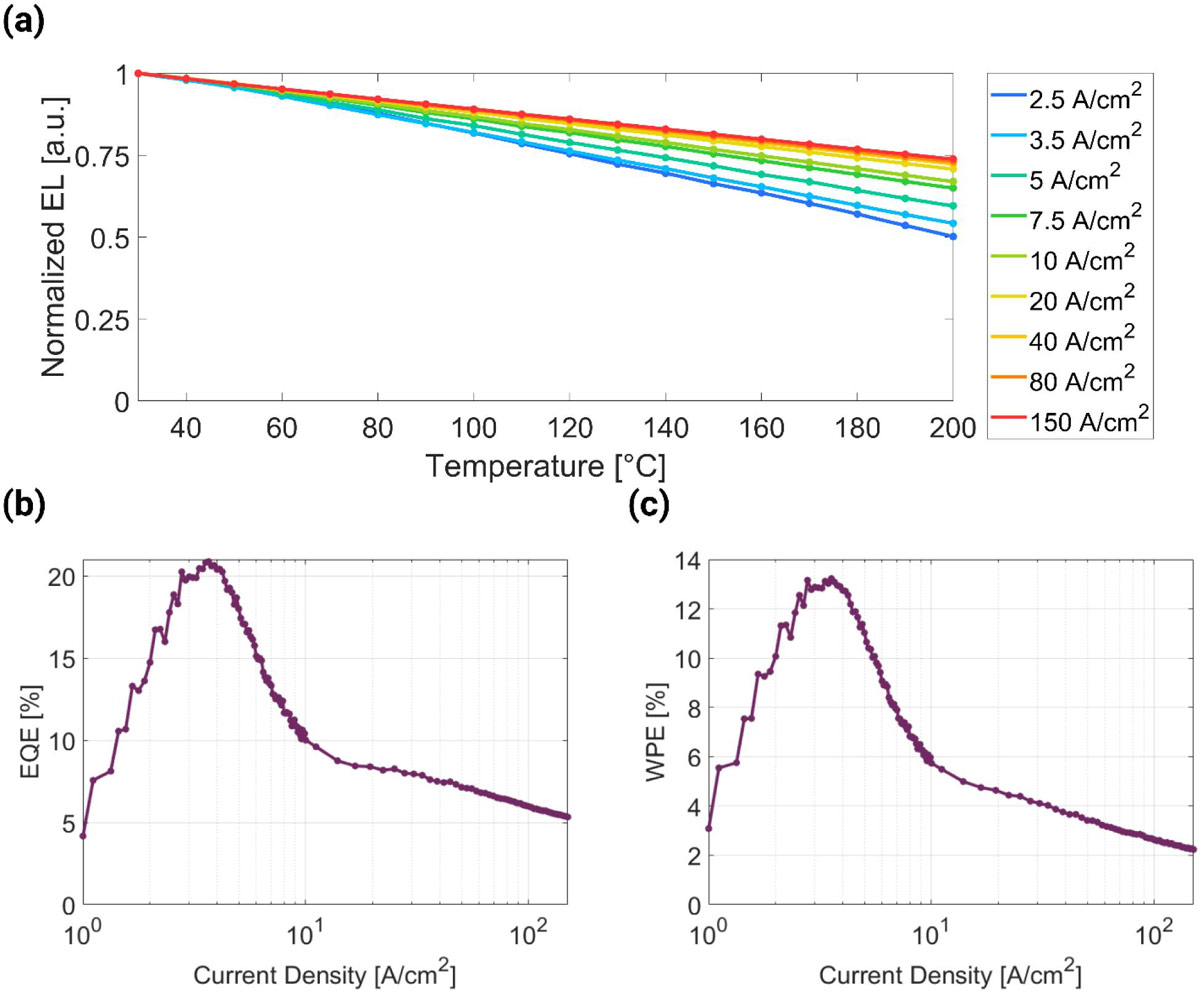
Figure 2: (a) Maximum value-normalized light output versus current density for different temperatures. (b) EQE and (c) WPE versus log-scale current density.
The peak EQE and WPE reached 20.8% and 13.2%, respectively (Figure 2). The team comments: “We attribute the EQE plateau at high current densities (i.e. excess of peak efficiency) to sequential quantum well injection and polarization-induced barriers at the GaN/InGaN interfaces.”
Red LEDs AlGaN InGaN GaN Sapphire substrates
https://doi.org/10.1021/acsphotonics.6c01611
The author Mike Cooke is a freelance technology journalist who has worked in the semiconductor and advanced technology sectors since 1997.